
By Kiera Jevtich, Recruiting Associate, Hawthorne Lane
Introduction:
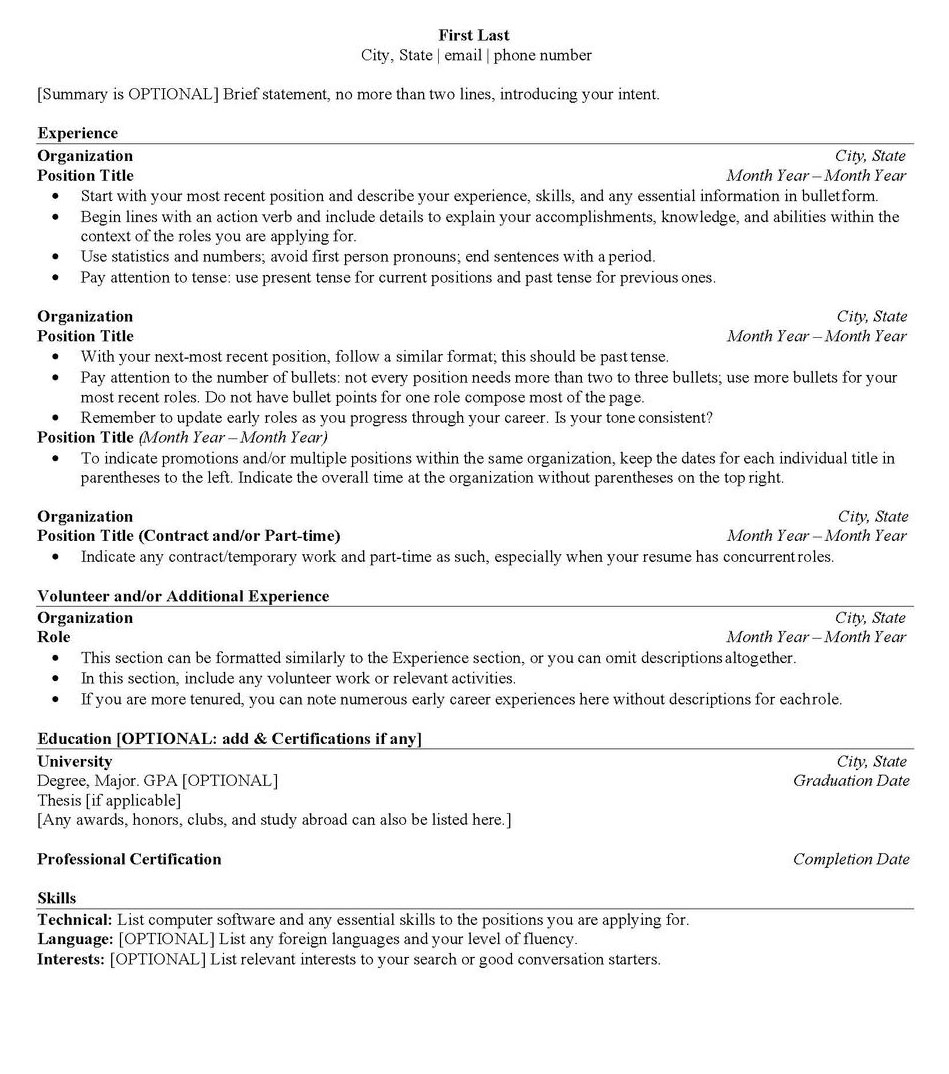
At Hawthorne Lane, we review thousands of resumes and have the unique advantage of hearing directly from employers about what they value most. While no two resumes should ever look exactly alike, there are proven best practices that can help position you for success. Our template is inspired by the Harvard resume format, with modifications made by the Hawthorne Lane team based on our experience recruiting administrative and operations professionals.
Because we primarily serve corporate and private-sector employers, our recommendations reflect what we see in our market. However, it is important to research the expectations of your specific industry and region. A corporate resume, a federal government resume, and a clinical healthcare resume will each look different because they are designed for different audiences. Use this guide as a strong foundation, but apply your own research and judgment when tailoring your resume.
Organizing:
Resumes are not one-size-fits-all, but simple formatting tends to be better. Think of your resume as a living document organized in reverse chronological order. The most current and relevant information should be highlighted first. Save the skills section for the bottom. If you recently earned a degree or are currently pursuing one, your education can go to the top. However, if your work experience is more recent and relevant, place your education in a lower section. It is essential that all information provided on your resume should always be up to date. If you are currently employed, list your current role as “Present” and use the present tense when describing core responsibilities. If you are no longer employed in a role, use past tense.
Accuracy:
Always ensure both accuracy and honesty. Your resume is an official document to be reviewed by prospective employers. It is essential that titles, dates, education, and any other details included are correct and updated. Your resume will be the framework for any interview processes, reference checks, and background checks. Upon extending an offer, employers will likely need to verify all employment dates and education. Double check the content being provided before sending a resume out.
AI:
AI should be used as an editor and a guide, never as a replacement. Never use generative AI to create a resume from scratch and present it as your own work. Let your own voice come through. AI can be utilized to proofread your resume for clarity and to check grammar and spelling. Remember: Do not enter personal or sensitive information into generative AI platforms.
Formatting:
Pay attention to your file name, as it is visible to employers. Keep it concise. Choose something along the lines of “Last Name, First Name – Resume” or “First Name Last Name Resume.”
Formatting will depend on the platform, but here are some general guidelines to help set up the page.
- Margins: Wide.
- Spacing: Single.
- Font: Choose something clear and legible, such as Arial, Times New Roman, or Calibri.
- Font size: Between ten and 12 points – whatever keeps your resume as close to one page as possible.
- Tip: If your resume is just over one page, reduce your font size by one or two points.
- Alignment: Left-align the content but center your name and contact information.
- Do not include photos or headshots; use those on your LinkedIn profile instead.
Use bold for section titles and italicize cities and dates. Generally, black font is the most legible. If you prefer to use color, choose a dark shade and limit it to your name or section titles. For consistency, spell out numbers less than ten.
Length:
A resume should be as close to one page as possible. For more seasoned professionals, two pages may be appropriate, but shorter is generally better. Your name should be prominent at the top in a font that does not take up excessive space. Be sure to include your contact information so recruiters and employers can reach you directly. An email address and phone number are typically sufficient. If applicable, include a link to your LinkedIn profile. Tip: Are the dates and job titles on your LinkedIn profile accurate and consistent with those on your resume? In addition to your contact information, it is helpful to include your current location. If you are relocating, clearly indicate this. For example: “Pittsburgh, PA | Relocating to Washington, D.C.”
Summary:
Is a summary section necessary? The short answer: No. The longer answer: Your resume should begin with your most recent experience. Summaries can be lengthy, take up valuable space, and often repeat the roles and skills listed below. A resume can still be complete without one. If you choose to include a summary, keep it to a brief statement of intent, no more than two lines. Think of it as a hook rather than an explanation. For example: “Recent graduate seeking entry-level administrative roles,” “Corporate Paralegal with 15+ years of litigation experience,” or “Hospitality professional looking to pivot into corporate events.”
Experience:
In your experience section, begin with your current or most recent position. List the organization on the left, the dates on the right, and your position title on the line below. Describe your experience with a concise set of bullet points, generally between two and six. The most relevant roles should include more bullet points than older positions. If you have many previous roles, consider listing earlier positions under a single “Additional Experience” section without bullet points. As noted in the template, use action verbs, include measurable results where possible, highlight major achievements, and pay close attention to verb tense.
When writing your resume, think about the roles you want to pursue. Review job descriptions and postings to identify key requirements. What duties, skills, industries, and technologies appear most often? Highlight applicable experience in your bullet points. For example, if you are primarily applying for Executive Assistant positions, it is helpful to mention common administrative responsibilities such as managing calendars, booking travel, and coordinating meetings. It is also beneficial to identify the titles of the people you supported and, where relevant, the number of individuals supported (e.g., supported the Vice President of Finance, supported two co-CEOs, supported 12 attorneys).
What can you highlight to market yourself as a professional? Think about what sets you apart. Do you have expertise in a particular field? Have you worked across multiple industries or at both small and large organizations? Demonstrate your growth. Have you been promoted or held multiple titles within the same organization? Differentiate those experiences with clear subheadings on your resume.
Volunteering & Additional Involvements:
Volunteer work and student organizations are valuable additions to a resume. Entry-level professionals can highlight involvement in student organizations in greater detail. Common examples include student government, volunteer leadership, cultural organizations, athletic participation, and musical or artistic activities.
Education:
Use the education section to list your degrees and professional certifications. If you are currently pursuing a degree, indicate that clearly along with your anticipated graduation month and year. Include the graduation month and year for each degree and highlight significant achievements such as GPA (if appropriate), honors, awards, scholarships, or academic distinctions. If you have completed some college coursework but have not earned a degree, use the phrase “Coursework completed” for clarity. The education section is also an appropriate place to include study abroad experiences and professional certifications.
Skills:
The skills section is another opportunity to be concise. Focus on technical platforms, software, languages, and job-specific skills that commonly appear in job descriptions. Long lists of soft skills are less impactful because they are difficult to quantify, so incorporate those qualities into your experience bullet points instead. If you choose to list interests, remember that this is a professional document.
Remember:
Your resume is meant to represent you, so be authentic. Take this advice with a grain of salt and use your best judgment.
Kiera Jevtich is a Recruiting Associate with Hawthorne Lane. Kiera joined the team new to the recruiting space and has quickly gained nearly a year and a half of full-cycle recruiting experience in the D.C. area market. While she supports both direct hire and temporary searches, Kiera specializes in placing candidates in temporary and temporary-to-hire roles. A people person at heart, Kiera is passionate about taking a thorough, friendly approach to supporting candidates’ job searches and connecting them with great short and long-term opportunities.